10 by 10 Pixel Art 10 by 10 Pixel Art Rowlet
How to make awesome pixel art
Think of retro games and you lot'll probably think of the pixellated look of titles released on consoles such every bit the NES.
Games such equally Bomberman and Kid Icarus worked within the limitations of 80s technology, yet offered hours of fun and some iconic looks.
The style faded into obscurity with the development of more than powerful game consoles and 3D graphics, but has seen a recent renaissance in indie games such as Savant: Ascent.
The art is still drawn pixel-by-pixel using a limited palette, but is much smoother thanks to careful shading and muted hues not available to 1980s game developers.
1 of the most pop uses of pixel fine art is in role-playing games based on an isometric filigree. We're going to create a character (or sprite) for apply in such a game.
1. Gear up your sheet
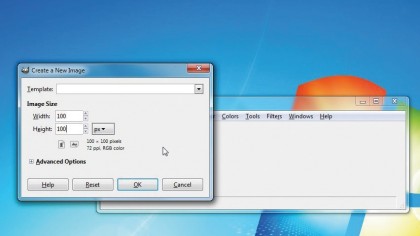
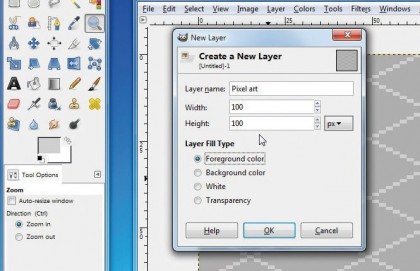
Start past creating a new epitome in GIMP, which is a gratis prototype editing awarding. A sail size of 100x100 pixels is plenty - much larger pieces of pixel art are possible, and look very impressive, but take weeks of piece of work to complete.
At present select the Pencil tool. This, Fill and Zoom are the only tools we'll be using, but first nosotros demand to alter some settings so we can draw individual pixels.
2. Sharpen your pencil
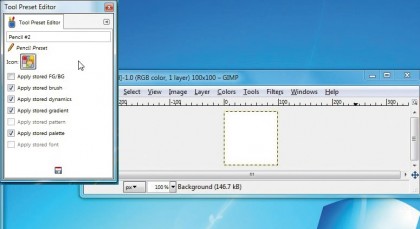
With the pencil selected, click Castor Type and select 'one pixel'. Alter the size to 1 and turn dynamics off. Deselect Apply Jitter and Smooth Stroke.
You can relieve information technology every bit a preset by clicking the blue floppy disk icon at the lesser allow of the toolbox. Click on New Tool Preset, requite it a handy proper noun like 'Pixel fine art' then the floppy disk icon to salve it.
three. Zoom in
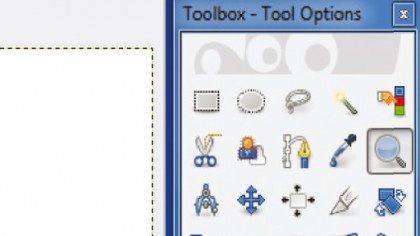
Use the Zoom tool to take a closer look at your paradigm (about 550% should exist fine, although it will depend on your monitor'southward resolution).
You want to be able to see and manipulate each pixel easily. Make sure you zoom out periodically while you're working to check that your fine art looks okay when viewed at actual size.
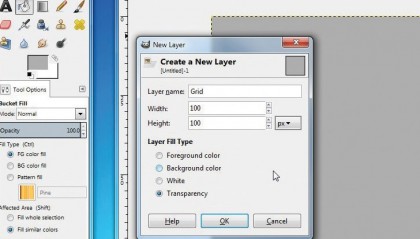
four. Paint it grey
We need to brand careful apply of shadows and highlights to ensure our pixel art character looks three-dimensional. Select the Bucket Make full tool and make the whole image a medium gray colour.
This neutral groundwork shade will make it easier to judge how bright to make highlights, and how dark to brand shadows.
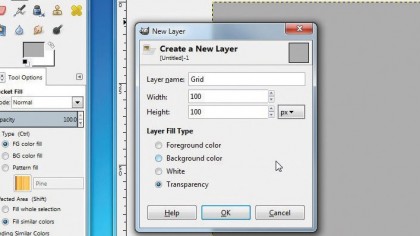
5. Create a guide
At present we're going to create an isometric grid every bit a guide to making pixel art. Create a new layer and call it 'Grid'. Select the pencil tool and choose a different shade of grey.
Now click the top left pixel of your image, and so concord [Shift] and motility your mouse pointer to the right-paw side. When the co-ordinates at the bottom left read '99 49', click to draw a line.
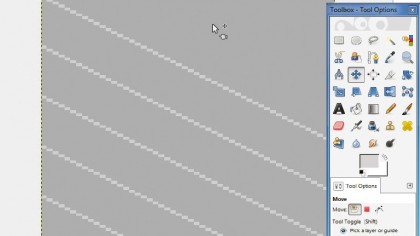
six. Line it up
Click Ctrl + C to copy the line and Ctrl + 5 to paste it, so select the Move tool and move the pasted line a footling beneath the original.
Click on the groundwork to deselect the line, and so copy and paste both lines. Echo the process until the paradigm is filled with evenly spaced diagonal lines.
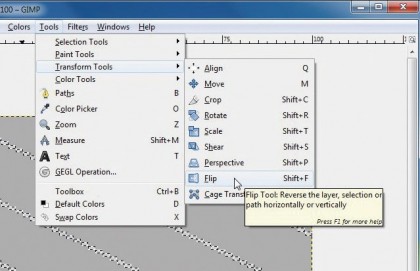
7. Build a grid
Now copy and paste all the diagonal lines, just don't deselect them. Instead, click Tools > Transform tools > Flip. Click in one case anywhere on your image to flip the copied lines.
This will give you an isometric filigree. Because it'southward on its ain layer, you'll exist able to delete it easily when you've finished.
8. Selection a subject
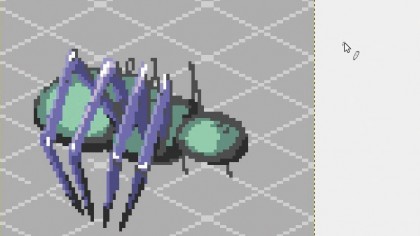
Create a new layer and call it 'Pixel fine art'. The side by side stride is largely up to yous, simply nosotros're going to draw a spider-like creature, which could be an enemy in a computer game.
Make sure you use the grid as a guide to help you become the right perspective, and don't employ any tools other than your customised Pencil and Fill up.
nine. Sketch it out
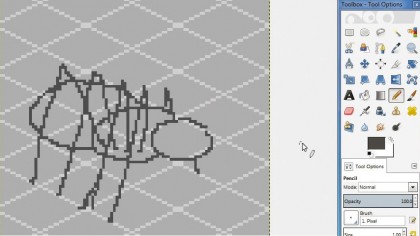
Take a leaf out of the classic artist sketchbook and offset elementary. Rather than trying to become every pixel perfect starting time time, make a crude sketch of your idea. Information technology'due south very easy to edit and refine every bit you continue.
Just make sure you use the isometric grid equally a guide, and always comport in mind that your graphic symbol is a 3-dimensional object.
ten. Refine it
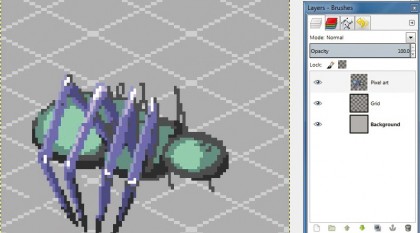
One time yous've got a rough sketch, try filling each section with a different colour to brand them easier to place. You can then decide where your light source is and begin adding shades and highlights appropriately.
Experience gratuitous to tweak; hither we've decided to make our spider's legs tilt inwards to make it look more conflicting.
11. Add texture
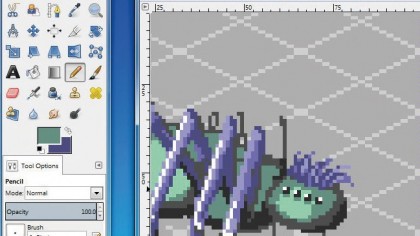
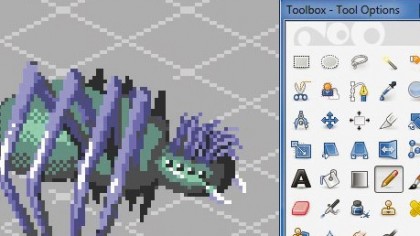
You lot should try to create the impression of different textures rather than making your grapheme uniformly smooth. Here, we've decided to give our spider some fur on its head, using 'strokes' of differing shades to stand for sections of hair.
Zoom out regularly to check that your texture effects work when viewed at 100%.
12. Endeavour dithering
Early videogames required pixel art that used every bit few colours as possible. Ane mode to get around these limitations was to apply dithering, a chequerboard of lighter and darker pixels that blends together to look like a single, mid-toned colour. Give it a endeavour!
You tin can create an interesting texture if the two colours are quite different.
13. Ready to export
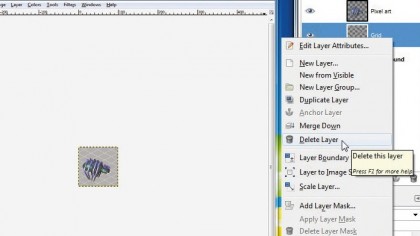
One time you're happy, click on the Grid and Background layers in the right-paw palette and delete them. At present click File > Consign As.
We want to proceed our transparent background, which ways saving it in either PNG or GIF format. Don't salvage it as a JPG – this format doesn't support transparency and the compression volition ruin your intricate art.
14. Keep it transparent
Select a file type from the drop-downwardly list and give information technology a name. At the next dialog box, uncheck Salvage Background Colour and 'Save colour values from transparent pixels', so click Export.
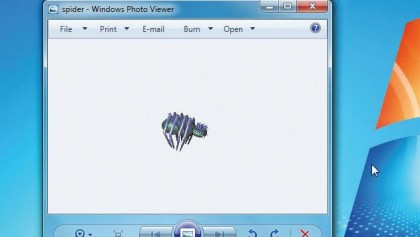
Your finished pixel art volition now be saved with a transparent background, ready for use in a game, as an icon on your desktop, or on a web page.
15. Convert to ICO format
I of the easiest ways to use your pixel fine art is to convert it into an ICO file and use it to supersede ane of the program icons on your desktop.
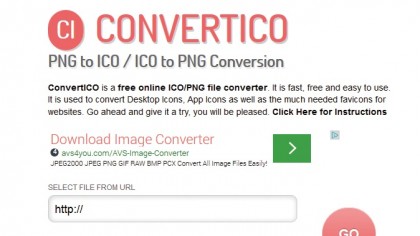
You can do this using a website called ConvertICO. Simply browse for the PNG or GIF file on your calculator, then click the 'Become' button and it will be converted instantly.
16. Use on the desktop
You'll run into a preview of your icon on the right-hand side of the page. Click the big arrow and download the icon to a user-friendly place on your computer.
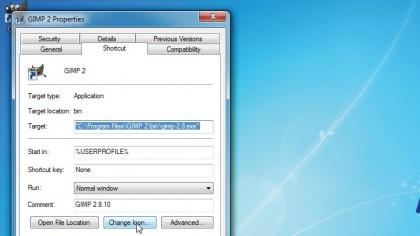
Now go to your Windows desktop, right-click an icon and select Properties. Click Change Icon, browse to your newly made ICO file and click OK. Click Apply, and enjoy!

Post a Comment for "10 by 10 Pixel Art 10 by 10 Pixel Art Rowlet"